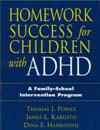
|
 |
ISBN# 1-57230-616-5
Homework Success for Children with ADHD
Publication Date: 2001 |
 |
Thomas J. Power, Ph.D.
James L. Karustis, Ph.D.
Dina F. Habboushe, Ph.D. |
|
|
|
|
|
|
About the Author |
| Thomas J. Power, Ph.D., is codirector of the ADHD/School Problems Program and acting director of the Section of Pediatric Psychology at Children's Seashore House of the Children's Hospital of Philadelphia, PA. Faculty appointments include assistant professor of school psychology in pediatrics at the University of Pennsylvania School of Medicine and adjunct associate professor of school psychology at Lehigh University. Dr. Power is currently associate editor of School Psychology Review and has authored numerous publications related to the assessment and treatment of ADHD.
James L. Karustis, Ph.D. is a licensed psychologist and nationally certified school psychologist in private practice in Downington, Pennsylvania. He was formerly a psychologist at Children's Seashore House of The Children's Hospital of Philadelphia and a Clinical Associate in Pediatrics at the University of Pennsylvania School of Medicine. Dr. Karustis is a well-known speaker and writer on ADHD in the Delaware Valley. Dr. Karustis is a well-known speaker and writer on ADHD in the Delaware Valley. Dr. Karustis is a devoted father and frequent traveler to India.
Dina F. Habboushe, Ph.D., Post-Doctoral Fellow in Pediatric Psychology at The Children's Hospital of Philadelphia, conducted her doctoral sudies at MCP Hahnemann University in Philadelphia and served her internship at Harvard Medical School/Children's Hospital in Boston. Dr. Habboushe's clinical and research interests include behavioral interventions for children and families coping with ADHD and related problems. She also specializes in the promotion of adherence and coping strategies for children with chronic illnesses and disorders. |
|
Summary
For children with ADHD in grades 1-6, problems with homework have been shown to contribute to academic skills deficits, underachievement, and significant levels of parent child conflict. This manual presents the first empirically supported homework intervention approach specifically developed for families coping with ADHD. Grounded in a solid theoretical and empirical rationale, the book provides detailed instructions for setting up the program, recruiting and selecting participants, and conducting each of the seven sessions. Practitioners learn how to implement specialized instructional and behavioral interventions to facilitate collaborative home school relationships, foster effective study skills and work habits, and enhance family functioning and children's self-esteem. The program can be used with groups of parents and children or with one family at a time. Special features of the volume include detailed case examples; checklists for monitoring the integrity of interventions; recruiting instruments and outcome measures; and helpful parent handouts.
Reviews
"Authoritative and thorough. This book is both empirically supported and clinically sensitive. It provides needed rigor and integration to help meet the clear need for consolidated efforts between home and school for youth with ADHD."
-Steve Hinshaw, PhD, University of California, Berkeley
"This book provides a practical road map for anyone wishing to implement a successful homework program for children and their families. It is designed for students with ADHD, but its applications are not limited to this group alone. The ideas and procedures could be used with just about any student having homework problems. The book is a treasure trove of practical ideas, covering everything from implementing positive motivational strategies, to assessing problems, to troubleshooting, follow-up, and family support. Anyone working with students who are having academic difficulties should have this valuable book."
-William R. Jenson, PhD, University of Utah
"This book presents an innovative program that is ideal for implementation when homework has become a frustrating battle that nobody wins. The assessment measures, session scripts, treatment integrity checklists, and parent handouts provided will enable practitioners to quickly get the Homework Success program up and running in their schools or clinics. Clear and informative, the book does an excellent job of demonstrating how to incorporate a behaviorally based approach within a collaborative family school framework."
-Leslie Rescorla, PhD, Bryn Mawr College
Contents
Preface
- Introduction to Homework Success.
- Background and Justification.
- Recruiting and Screening Participants.
- Assessing Intervention Integrity and Evaluating Outcomes, with Sheeba Daniel.
- Setting Up the Program: Practical Considerations.
- Initiating the Program
- Group Session 1: Introducting Homework Success.
- Group Session 2: Establishing Homework Ritual and Giving Instructions.
- Group Session 3: Providing Positive Reinforcement.
- Group Session 4: Managing Time and Setting Goals.
- Group Session 5: Using Punishment Successfully.
- Group Session 6: Integrating Skills and Anticipating Future Problems.
- Group Session 7: Providing Follow-Up Support.
- Including Children in Homework Success, with Stephen S. Leff, Tracy E. Costigan, Suzanne G. Goldstein, and Sheeba Daniel.
- Assessing Outcomes: Case Illustrations, with Sheeba Daniel.
- Conclusions.
Appendices:
- Recruiting Handout and Letters.
- Recruiting Instruments and Outcome Measures.
- Integrity Checklists for Parent Group.
- Parent Handouts.
- Materials for Child Group.
|
|
|
|
|